Thomas Krendl Gilbert, a machine ethicist, told the journalist Sharon Goldman in September 2023 that he means something literal when he calls AI alchemy: “The people building it actually think that what they’re doing is magical.” The interview prints the sentence as his view, with no source attached to it. Both halves of it can be checked, because it says something about what builders believe and rests on an analogy that says something about what alchemists did.
Two groups need names. Builders are the people who train and develop the largest language models, which are programs trained on text to produce text. Gilbert’s claim is about builders. Practitioners are the wider group who use such models in their work, hobbyists included.
The record documents magic vocabulary among builders and practitioners, meaning words such as magic, spell, incantation and alchemy applied to the work. It also documents that two builders say plainly that they do not understand how their systems do what they do. Scholars document an enchanted discourse, talk that presents the systems as magical, about their uninterpretable mechanisms and counter-intuitive behaviour. Product names and Altman’s own words apply the same vocabulary to the product.
On the alchemy side of the analogy, historians dispute whether alchemy was magic. The historian William Newman holds that alchemists did not, as a rule, regard their work as magic, and others point to texts that join the two. Newton’s notebooks record furnace work with measured yields, and the Key of Solomon, a book of ritual magic, survives in late manuscripts and in Mathers’s edited translation of 1888, which show some of the anthropologists’ marks of magic.
The evidence on what builders believe is a survey of expectations, informal interviews and journalism, and each measures something different.
The account of alchemy rests on historians and on printed translations. I read no alchemical manuscript.
Gilbert’s claim
Goldman’s AI Beat piece of 18 September 2023 names no builder as holding the belief and reports no observation of what any builder believes. She wrote it after a video call, and her article of 20 September repeats the sentence. Gilbert says the belief is “rooted in a lot of metaphors, ideas that have now filtered into public discourse over the past several months”.
Gilbert gives two further reasons. The first is scaling, the practice of raising the data and computation used to train a model. In Goldman’s account he explained that the prevailing idea is that “intelligence itself is scalar”. The second is secrecy: of alchemy he says “It was very secretive, and frankly, that’s how AI works right now”. He places the magic of generative AI in the interface: “The magic comes from the way the model is matched to the interface.”
Gilbert also describes what builders need to know. In the same interview he says that they “don’t need to know what the mechanisms are” that make the technology work, and that they are “interested enough and motivated enough and frankly, also have the resources enough to just play with it”. He calls the goal of arbitrarily intelligent systems “an inherently mystical or supernatural claim”.
On his podcast The Retort, in an episode of 29 September 2023, Gilbert restates the claim and narrows it. He says that “I meant literally that many of those people think of themselves as doing a kind of magic”, and he restricts “those people” to the younger generation at the companies building the largest models, whose motive he calls “fundamentally supernatural”. I read the podcast through its auto-generated captions and corrected their recognition errors in the quotations.
His co-host Nathan Lambert, a Hugging Face researcher, objects in the same episode: “I don’t know if anyone seriously has ever told me that these things are magic”. Gilbert concedes part of the point: “it only really becomes Alchemy when it turns into PR”. He adds “I actually don’t think that’s the entire story here”.
In Goldman’s article of 20 September, Gilbert answers his critics and names companies. He says that much of the field’s energy and funding “comes from people who are not motivated by science, and on the contrary sincerely believe they are inaugurating a new era of consciousness facilitated by ‘superintelligent’ machines”. He places that younger generation at “LLM-focused companies like OpenAI or Anthropic”, and he says: “The alchemists are now in charge.”
By January 2025 the claim has become one about the field’s assumptions, which he calls “metaphysical beliefs about rationality which are not falsifiable”. The word magic does not occur in that passage. The claim tested here is the version of September 2023.
Magic
The anthropological definitions of magic supply marks that can be held against a practice. The marks used here are drawn from Bronislaw Malinowski’s essay Magic, Science and Religion and from his summary of other authors in it. Page numbers are those of the 1948 reprint:
- Magic “always has a definite aim intimately associated with human instincts, needs, and pursuits” (Malinowski, p. 66).
- It “is also governed by a theory, by a system of principles which dictate the manner in which the act has to be performed in order to be effective” (Malinowski, p. 66).
- It depends on a spell: “To the natives knowledge of magic means knowledge of spell” (Malinowski, p. 54).
- It is handed on: magic “had to be handed over in direct filiation from generation to generation” (Malinowski, p. 68).
- It rests on “the belief that hope cannot fail nor desire deceive” (Malinowski, p. 67).
- Its failures are accounted for: “the failures of magic can be always accounted for by the slip of memory, by slovenliness in performance or in observance of a taboo”, and by the “counter-magic” of someone else (Malinowski, p. 66).
- It is “made by tradition” and “occult, taught through mysterious initiations” (p. 3). These two phrases are Malinowski’s summary of the views of Preuss, Marett, Hubert and Mauss.
Malinowski names the technique of magic in one phrase: “spell, rite, and the condition of the performer form always its trite trinity” (p. 68). The spell in the list above is one part of that technique.
Campolo and Crawford report that the early anthropologists, from Tylor to Frazer, conceived of magic as “essentially mistaken premodern practices that science would replace”. Malinowski instead writes that “Magic is akin to science in that it always has a definite aim” (p. 66). I use these marks because each can be checked against a record.
Mauss and Hubert define magic by social position. A magical rite “does not play a part in organized cults”, and it is “private, secret, mysterious”.
The philosopher’s stone
The philosopher’s stone is the substance that the alchemical texts say transmutes base metal into gold or silver, and in some texts also heals. Newman, in an interview for NOVA, says that “Alchemy really encompassed all chemical technology” and that it “also included the attempt to make the ‘philosophers’ stone.’”
Newman and Principe call the whole enterprise chymistry, because the early modern terms alchemy and chymistry were, in Newman’s phrase, “largely synonymous”. A chymist is a practitioner of chymistry. This post calls such practitioners alchemists.
The texts describe the agent of transmutation as a material and treat the elixir and the stone as one thing: William Lilly, reporting a story at third hand, writes of “the Elixir or Philosopher’s Stone”. Boyle, in the Sceptical Chymist of 1661, writes of what happens “if a Tantillum of the Red Elixir be mingled with the Saturn”. A tantillum is a very small amount, and Boyle’s Saturn is lead, since the lead “seems to have quite lost its Properties that made it be call’d Lead”.
In the account of the curator Jennifer Rampling at Princeton, George Ripley’s authentic writings describe two stones. One is a transmuting mineral stone made from mercury and green vitriol (modern iron sulfate). The other is a medicinal vegetable stone made from red lead (modern lead tetraoxide).
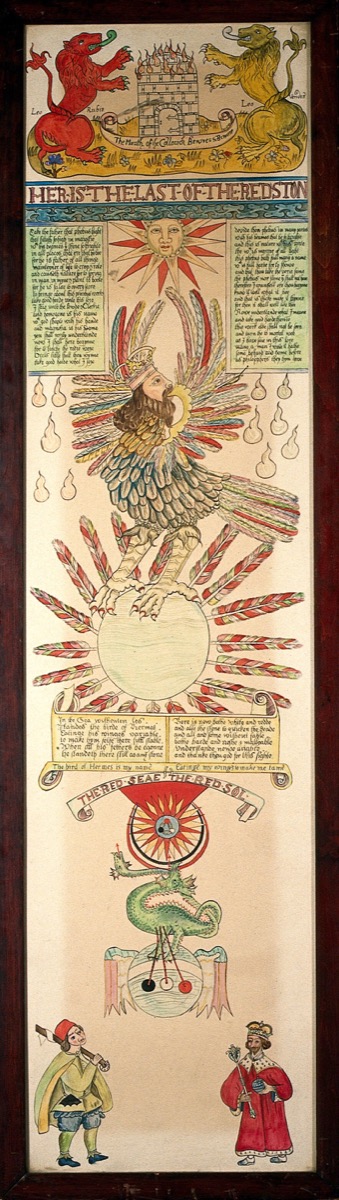
The stone also had a devotional register. In Nummedal’s account, Khunrath in 1595 compared “the healing power of the philosophers’ stone to the redemptive powers of Christ”. Jung and Eliade read alchemy as a psychological or religious experience, in Calian’s survey. Newman and Principe reject that reading, and Calian holds that a spiritual dimension is essential to alchemy and that they eliminate it.
Newman holds that alchemy was not magic, as a rule. In his Princeton interview he calls the opposite view “a popular modern misconception that alchemy, astrology, and magic were all part and parcel of the same ‘occult’ enterprise”. He traces the category of the occult, which joins alchemy with magic, to the nineteenth-century Romantic movement, in The Unknown Newton.
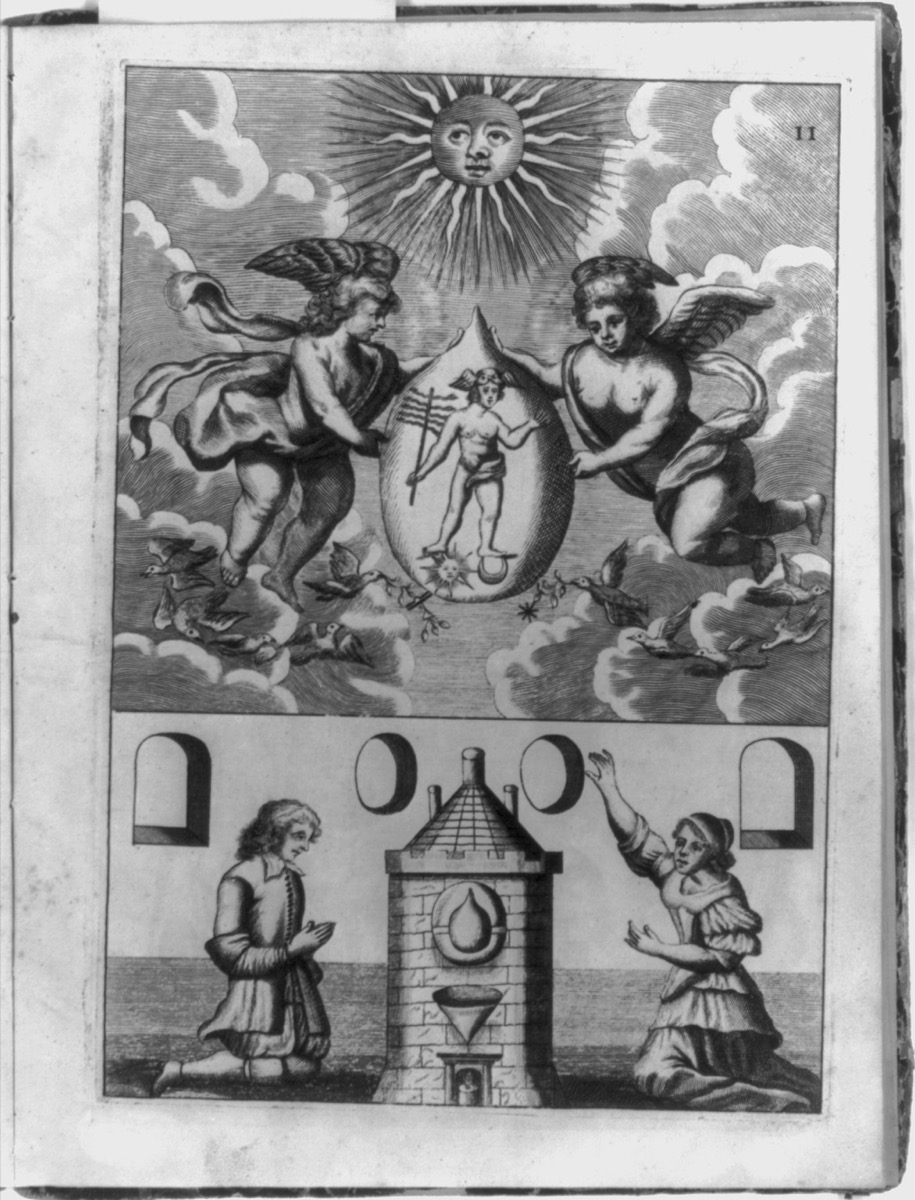
Two kinds of evidence count against him. The Britannica entry on magic lists alchemy among “Practices classified as magic”, which is the classification Newman calls a modern misconception. Khunrath’s Amphitheatrum of 1609 calls itself “Christiano-Kabalisticum, Divino-Magicum, nec non Physico-Chymicum”, and its Oratory and Laboratory plate shows, in Princeton’s words, that “the alchemist prays in the oratory, the realm of God” while “a well-equipped laboratory represents the realm of Nature”. Newman’s answer is that the two disciplines “could overlap but were not by any means identical”.
Secrecy is the feature Gilbert’s analogy relies on, and alchemy had it too. Newman says the treatises claim that knowledge of the stone must be kept secret “because if it gets out to the world that a particular alchemist has it, he’ll be strangled in his bed to extract the secret”. The reason he reports is the alchemist’s personal safety.
Newton’s laboratory
Keynes held that Newton’s alchemical papers were magic. He bought alchemical papers at the Sotheby sale of 13 and 14 July 1936. In Newton, the Man he wrote that Newton “was the last of the magicians” and that the papers are “wholly magical and wholly devoid of scientific value”. He judged that Newton was concerned “not in serious experiment, but in trying to read the riddle of tradition”.
The papers are large. Newton wrote and transcribed about a million words on alchemy, by the count of the Chymistry of Isaac Newton project, which Newman and colleagues run. Newman, the general editor of the alchemical texts there, disagrees with Keynes on the label. In The Unknown Newton he writes: “Newton was neither the last of the magicians nor the first of the age of reason; his alchemical labors were the stock-in-trade of early modern experimental science.”
He also notes that two Newton notebooks of 452 pages contain the word “God” once, against Dobbs’s reading of Newton’s alchemy as a religious quest.
The notebooks record work done at a furnace. Humphrey Newton, quoted by Keynes, recalled “about 6 weeks at spring and 6 at the fall when the fire in the elaboratory scarcely went out”. One recipe for spirit of salt, now called hydrochloric acid, reads: “urge by a graduall fire out of a glass retort filld full into a large receiver till you feel the receiver cold & one pound will yeild nine or 10 ounces.” The recipe states a yield that a reader can check.
The Newton project’s page on Chymical Products describes the star regulus. It says that antimony metal “can be made to form a visibly crystalline structure by slowly cooling the molten antimony beneath a thick layer of slag”, and that Starkey named an alloy “the net” “because of the minute, regular crystals on its surface”. A caption on the NOVA interview page says that Newman “cooked up a molten alloy of copper and star-regulus in his crucible”, and another calls the result “likely similar to the alloy Newton produced 300 years ago”.
Newman’s guide to the alchemical manuscript says that Newton in the mid-1670s “had not yet fully deciphered Starkey’s recipes”, and that Starkey published his Marrow of Alchemy under the pseudonym Eirenaeus Philalethes. In the Princeton account, Starkey crafted the persona of Eirenaeus Philalethes, “a fictive American adept”.
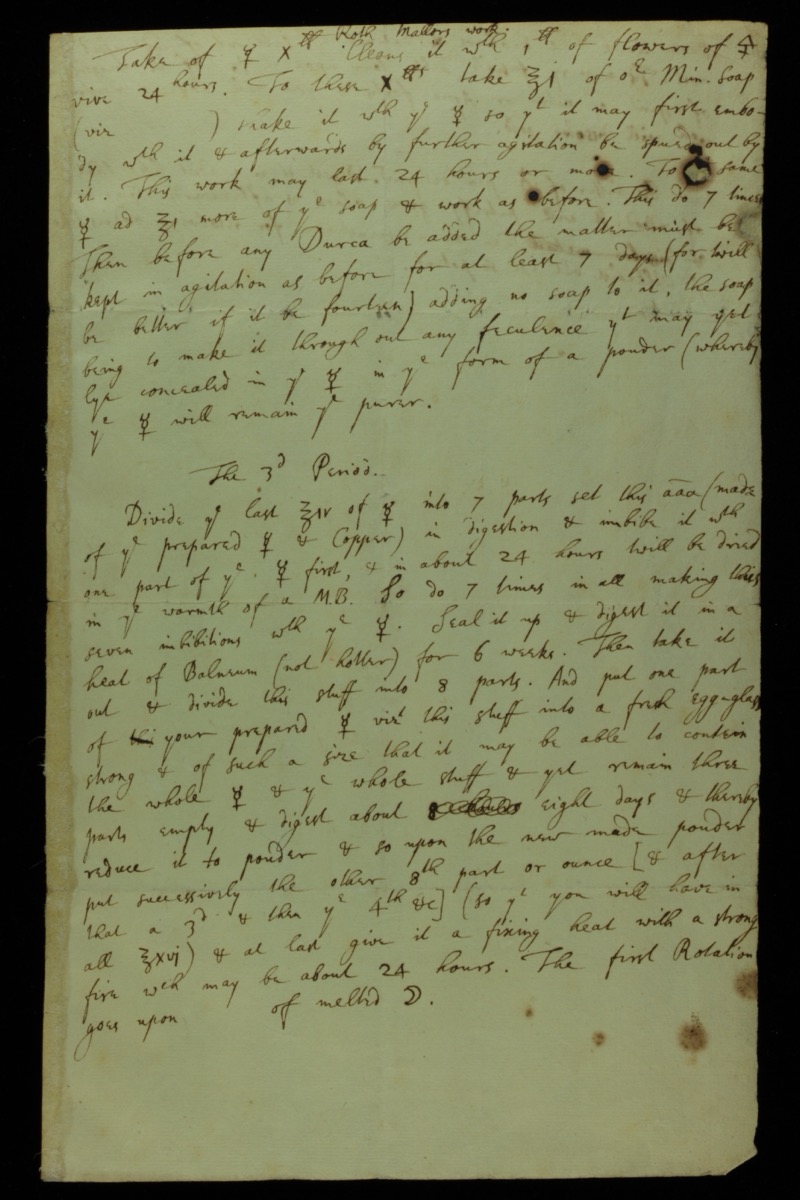
Newman and Keynes describe the same papers. In his reassessment of Newton’s alchemy Newman writes that “The recapitulation and attempted decipherment of similar processes in fact make up the bulk of” them. In my reading, Keynes and Newman agree that much of the labour was decoding riddling texts, and they differ on whether decoding a recipe at a furnace is magic.
The Newton Project’s list of books Newton is known to have owned includes Agrippa’s De occulta philosophia and Porta’s Magiae naturalis. The Key of Solomon is not among its entries, and the list says it is not comprehensive.
The Key of Solomon
The manuscripts behind the Key of Solomon (Clavicula Salomonis), a grimoire or book of instructions for ritual magic, are late. Joseph Peterson, who edits grimoires and is no academic historian, gives the earliest reference as 1303-10, in Peter of Abano’s Lucidator, and the oldest Latin manuscript with the full text as “late 15th century”. In his introduction he notes that “none of the manuscripts used by Mathers qualify as ‘ancient’”, and that Mathers’s translation of 1888 is “almost entirely based on French Colorno manuscript exemplars dating 18th century”. The Key is the case of ritual magic against which the marks of magic are held here.
The procedure for the circle, in Book II, chapter IX of Mathers’s translation, begins: “take thou the Sickle or Scimitar of Art and stick it into the centre of the place where the Circle is to be made; then take a cord of nine feet in length, fasten one end thereof unto the Sickle and with the other end trace out the circumference of the Circle”. Beyond the circle go pentagrams “with the Symbols and Names of the Creator”, and outside these circles two squares. Mathers’s footnote says that “This Chapter is only given in 10862 Add. MSS.”, so the circle procedure comes from a single manuscript.
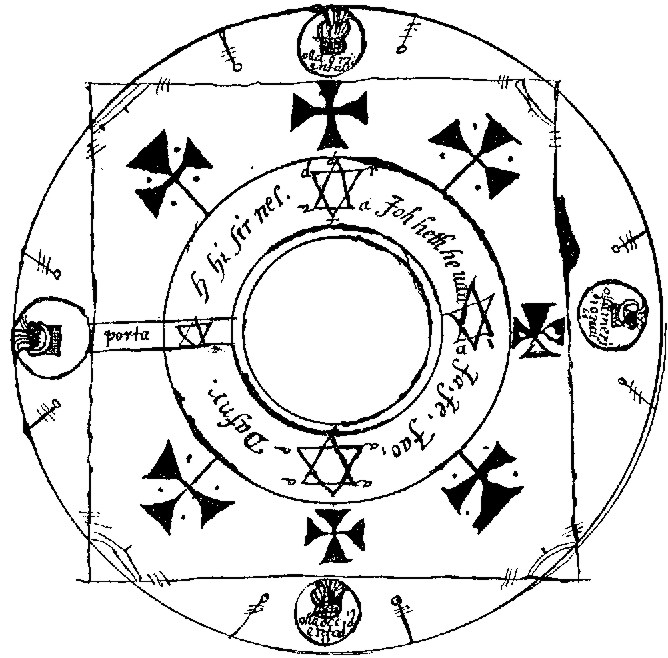
The pentacles, the inscribed figures the Key tells the operator to make, are tied to metals: “Saturn ruleth over Lead; Jupiter over Tin; Mars over Iron; the Sun over Gold; Venus over Copper; Mercury over the mixture of Metals; and the Moon over Silver.” Boyle’s phrase “the Saturn” for lead, quoted above, uses the same pairing.
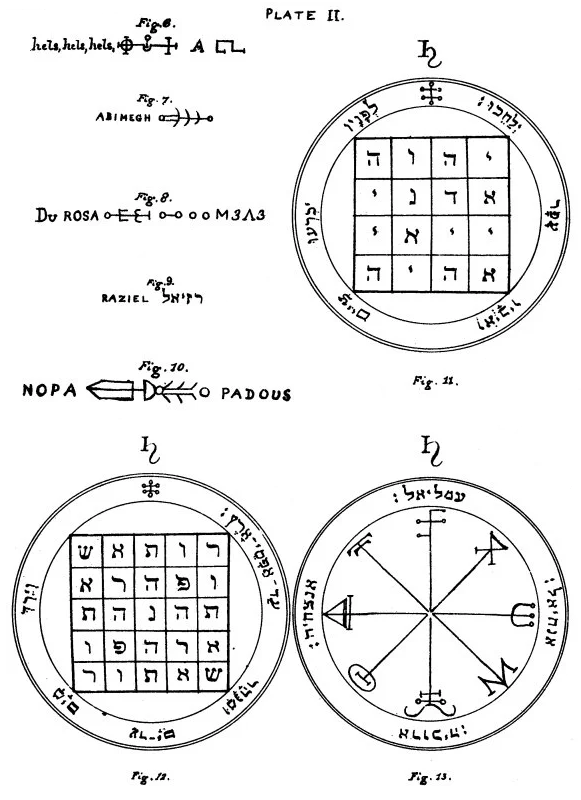
The text as read today is an edited one. Mathers was a proponent of the book’s use, and his preface says he omitted “one or two experiments partaking largely of Black Magic”. Peterson reports that three of the four significant excisions concern love magic and the fourth is chapter 14, on hate and the destruction of enemies.
The edited Key shows these of the marks listed above, as far as the sources support them:
- practical aims
- a procedure with named tools
- names and symbols written into the figures
- a text handed down in copies
Magic vocabulary
The one builder quoted here as using magic vocabulary is Ilya Sutskever. He wrote in 2019 that “ML is like alchemy, turning silicon into spirits and ghosts” and in 2022 that “Alchemy exists; it just goes under the name ‘deep learning’”. In a talk of May 2023, as Goldman quotes it, he said: “We built the refinery, the alchemy, which takes the data and extracts its secrets into the neural network, the Philosopher’s Stones, maybe the alchemy process.”
In the same answer he said “we did not build the thing, what we build is a process which builds the thing”. Of what the process produces he said: “But then the result is so mysterious, and you can study it for years.”
Others use the same words for ignorance. Campolo and Crawford collect Stuart Russell’s “it’s still a kind of magic” and Pedro Domingos’s “black art”. The hackers’ own Jargon File defines magic as “As yet unexplained, or too complicated to explain”. Its entry for voodoo programming reads “The use by guess or cookbook of an obscure or hairy system, feature, or algorithm that one does not truly understand”, and adds that “the technique may not work, and if it doesn’t, one will never know why.” Its entry for magic gives a second sense: “Characteristic of something that works although no one really understands why”, which it calls black magic.
Leon Derczynski’s interview study is the record of how practitioners talk. He reports 30-40 hours of interview data from “just a few dozen” people, in an informal blog post with no counts. His interviewees were “machine learning professionals, security consultants, artists, big tech directors, programmers, hobbyists, academics”.
Some of them “intentionally adopted the language of magic” and describe their work with “the terminology of demon summoning, spellcasting, binding and so on”. The words came up “from research directors, security professionals, machine learning experts”. One participant said “Prompting is a pseudoscience. It’s kind of like alchemy, where it’s not exactly a science”.
Derczynski also quotes a few sources from outside the study and links each one. One of them, linked to Simon Willison’s weblog post of 5 June 2022 on using GPT-3, reads “It’s a programming activity that actually feels a lot more like spellcasting”.
A third said it helps to treat the work as a game, “that it’s just magic, and you’re just messing around things you don’t understand.” Derczynski reads the usage as metaphor: “it’s clear to those looking for precision that the words used are not actual descriptions of what’s going on”.
Prompts
A prompt is the text a user gives a language model to elicit an output. Charles Frye titled his 2023 bootcamp lecture Learn to Spell, and the page says in the same breath “Prompts are not literal magic spells; they are based on linear algebra.” Derczynski also quotes, from a post on X by the account simonw outside his study, “You’ll never know quite why something works, you just have to keep collecting increasingly bizarre incantations”. Goldman writes in her own voice that the DeepMind researchers “are unclear exactly why this incantation works”.
What a phrase in a prompt measurably does, and how its effect changes with the model, is the subject of post 3.
Ignorance of mechanism
Two builders say plainly that they do not understand their systems. Geoffrey Hinton told 60 Minutes in October 2023: “we designed the learning algorithm. That’s a bit like designing the principle of evolution.” He added “we don’t really understand exactly how they do those things.” Dario Amodei writes that “this lack of understanding is essentially unprecedented in the history of technology” (Amodei, 2025).
Amodei describes how the systems come to be. He attributes to his co-founder Chris Olah the saying that “generative AI systems are grown more than they are built”, and in my reading Hinton’s comparison with designing the principle of evolution makes the same point. Gilbert’s remark that builders “don’t need to know what the mechanisms are” describes the same state from outside.
By Newton’s standard, an effect that can be observed is a manifest quality even when its cause is unknown. Newton drew that line in the Opticks, Query 31 (Project Gutenberg eBook 33504). He writes of general principles that he considers “not as occult Qualities” but as “general Laws of Nature”, with “their Truth appearing to us by Phaenomena, though their Causes be not yet discover’d. For these are manifest Qualities, and their Causes only are occult.” He adds that naming an occult quality as the explanation “is to tell us nothing”.
I did not examine whether the behaviour of these models has been stated as laws in Newton’s sense, so the comparison covers the structure of the claim only.
The objection that remains is Amodei’s. Newton stated laws while the causes stayed open, whereas Amodei calls the present ignorance unprecedented, so builders may be describing a larger gap than the one Newton described. Whether the present gap is larger is open.
Product and public
Magic vocabulary about the product is documented, and its audience is the public. Sam Altman told the Financial Times, as The Decoder reports it, that ChatGPT, the API and the GPT store “aren’t really our products”. He went on: “Those are channels into our one single product, which is intelligence, magic intelligence in the sky.”
Altman also tied the word to the product’s errors. At Dreamforce 2023 in San Francisco, as ITPro reports, he said that “a lot of value from these systems is heavily related to the fact that they do hallucinate”. A system told to “never say anything that you’re not 100% sure about”, he said, “won’t have the magic that people like so much.”
In the cases quoted, Altman describes the work itself in terms of uncertainty. Of GPT-5 he told the Financial Times: “Until we go train that model, it’s like a fun guessing game for us.” Malinowski marks magic by “the belief that hope cannot fail nor desire deceive”, and a guessing game allows that outcomes can fail.
Product names carry the same vocabulary. Lupetti and Murray-Rust, in a CHI 2024 paper on the design of AI products, report a Chrome feature called Magical, a Figma toolset called Magician, and Runway’s header “AI Magic Tools”. The Figma toolset, in their quotation, is “A magical design tool for Figma powered by AI.”
Gilbert locates the magic in the interface and the PR. Campolo and Crawford locate the enchanted discourse elsewhere, in talk about “these systems’ uninterpretable mechanisms and counter-intuitive behavior”. In Enchanted Determinism they report three findings:
- Experts and observers alike “deploy enchanted, magical discourses” about deep learning.
- The discourse “is not reducible to marketing hype”.
- “Enchantment shields the creators of these systems from accountability”.
Weizenbaum, writing in 1966 about his program ELIZA, says that once a program is explained “its magic crumbles away”, and he wrote part of his paper to “rob ELIZA of the aura of magic”.
Belief
The evidence on what builders believe comes from a survey of researchers, from Derczynski’s informal interviews and from journalism. Each records a different thing.
The AI Impacts survey (arXiv 2401.02843) covers 2,778 authors from six top AI venues, run in October 2023 with a 15% response rate. A total of 912 respondents answered whether users of AI systems in 2028 will be able to know the true reasons for the systems’ choices, and 20% gave better than even odds. Asked about systems twenty years ahead, 69.1% of respondents thought they would be likely or very likely to “Frequently behave in ways that are surprising to humans”.
The same survey asked how far people’s concerns about future risks from AI are due to misunderstandings of AI research, and 44% of 671 respondents answered “To a large extent”. These figures measure what researchers expect about opacity and surprise, and what they think of the public’s understanding. The questions concern the systems and the public, and they ask nothing about magic.
Derczynski’s interviews measure vocabulary in use among practitioners of many kinds. The participant who called the work “just magic” gave the reason that the word keeps one from “believing your own hype about these models and its capabilities”, and Derczynski reads the usage as metaphor. His interviews record how people talk about the work and what they say the words are for.
The journalism reports belief about the purpose of the work. Karen Hao, reporting for a book, says that a “quasi-religious atmosphere is surrounding AI development and has gripped the minds of the people within Silicon Valley who are working on this”. She thought the talk was rhetoric at first, and “it’s not for many people. For many people, it is a genuine belief that this is what they are doing; this is their purpose.”
Kevin Roose reports that an AI executive called the shoggoth meme, a Lovecraft creature used to depict a model, “the most important meme in A.I.” and “only partly a joke”. His own reading is that “many of the people working on this technology are somewhat mystified by their own creations”, and that the meme reinforces the notion that what happens in AI “feels, to some of its participants, more like an act of summoning than a software development process.”
Hao and Roose draw on interviews with no stated sample, and they report belief and feeling about AI development in their own words. Lambert’s objection is a statement of his own experience as a researcher. Gilbert’s own version, that a generation “sincerely believe they are inaugurating a new era of consciousness”, names companies and no person.
Assessment
The record documents magic vocabulary among builders and practitioners, and the usage is old. Weizenbaum wrote of the magic of a program in 1966, and the Jargon File defines magic as the unexplained. Sutskever applies the word alchemy to the training process and calls its result “so mysterious”.
Practitioners use the same vocabulary for prompting, and the two sources that record it read it as a figure of speech. Derczynski records the words among the few dozen practitioners he interviewed and reads them as metaphor. Frye’s lecture page calls prompts spells and says in the same breath that they are “not literal magic spells”.
The same vocabulary includes names for poor practice. The Jargon File defines cargo cult programming as “A style of (incompetent) programming dominated by ritual inclusion of code or program structures that serve no real purpose”, and says of voodoo programming that “the technique may not work”.
Weizenbaum, Lupetti and Murray-Rust, and Altman’s own words document magic vocabulary about the interface and the product, which is where Gilbert places the magic. Campolo and Crawford document an enchanted discourse about the systems’ mechanisms and behaviour, and they find that it “is not reducible to marketing hype”.
On alchemy and magic, the historians disagree. Newman reads alchemy as chymistry, distinct from magic as a rule, and traces the occult grouping of the two to the nineteenth-century Romantic movement. On the other side stand the Britannica classification, Khunrath’s Amphitheatrum with its oratory beside the laboratory, and Keynes’s verdict that Newton “was the last of the magicians”. Newman answers that the two disciplines “could overlap but were not by any means identical”.
Under either reading, Newton’s notebooks record furnace work, and one recipe states a yield of “nine or 10 ounces” from a pound. The Key of Solomon, the case of ritual magic held against the marks here, survives in late manuscripts. Peterson dates the oldest full Latin text to the late fifteenth century, and Mathers based his translation of 1888 almost entirely on eighteenth-century copies and omitted some experiments from it. It shows practical aims, a procedure with named tools, names and symbols written into the figures, and a text handed down in copies.
Secrecy, the mark Mauss gives, is the one Gilbert relies on. Alchemists had it too, and Newman gives them a reason of personal safety. Ignorance of mechanism is documented in builders’ own words: Hinton says “we don’t really understand exactly how they do those things”, and Amodei calls the lack of understanding “essentially unprecedented in the history of technology”. Newton’s standard treats an observed effect with an unknown cause as a manifest quality.
The evidence on belief measures different things. The AI Impacts survey measures expectations: 20% of 912 respondents gave better than even odds that users in 2028 will know the true reasons for a system’s choices. Derczynski’s interviews measure vocabulary and its stated purpose. Hao and Roose report, from interviews with no stated sample, a quasi-religious belief about the purpose of AI development and a feeling of summoning among some participants, and Lambert reports his own experience.
Gilbert’s claim of January 2025, that the field holds “metaphysical beliefs about rationality which are not falsifiable”, is a different claim from the one examined here.
The question the record leaves is whether the younger generation at the largest-model companies thinks of itself as doing magic. A study that sampled builders at the companies Gilbert names, OpenAI and Anthropic among them, and asked what they believe about their work against the marks listed in the Magic section, would answer it.
References
- Amodei, D., “The Urgency of Interpretability”, 2025. https://www.darioamodei.com/post/the-urgency-of-interpretability
- Boyle, R., The Sceptical Chymist, 1661, Project Gutenberg #22914. https://www.gutenberg.org/ebooks/22914
- Britannica, “magic”, Encyclopaedia Britannica. https://www.britannica.com/topic/magic-supernatural-phenomenon
- Calian, G.-F., “Alkimia Operativa and Alkimia Speculativa: Some Modern Controversies on the Historiography of Alchemy”, Annual of Medieval Studies at CEU 16, 2010. https://ams.ceu.edu/2010/Calian.pdf
- Campolo, A. and Crawford, K., “Enchanted Determinism: Power without Responsibility in Artificial Intelligence”, Engaging Science, Technology, and Society 6, 2020. DOI 10.17351/ests2020.277. http://estsjournal.org/index.php/ests/article/download/277/205
- Chymistry of Isaac Newton project, Indiana University. https://webapp1.dlib.indiana.edu/newton/
- Chymistry of Isaac Newton project, “Chymical Products”, Indiana University. https://webapp1.dlib.indiana.edu/newton/reference/chemProd.do
- Derczynski, L., “The Language Model Vocabulary Gap. And why magic maybe isn’t a terrible metaphor”, 23 January 2023. https://interhumanagreement.substack.com/p/demons
- Frye, C., “Learn to Spell: Prompt Engineering”, Full Stack Deep Learning LLM Bootcamp, 9 May 2023. https://fullstackdeeplearning.com/llm-bootcamp/spring-2023/prompt-engineering/
- Gilbert, T. K. and Lambert, N., The Retort AI Podcast, “E3: As Above, So Below: Alchemy, AI Safety, and RLHF”, 29 September 2023. https://www.youtube.com/watch?v=AOJgMq0FDU0
- Gilbert, T. K. and Lambert, N., The Retort, “We ask again: Is AI a science?”, 10 January 2025. https://www.youtube.com/watch?v=DkipmCFX0OE
- Goldman, S., “Today’s AI is ‘alchemy,’ not science: what that means and why that matters”, The AI Beat, VentureBeat, 18 September 2023. https://web.archive.org/web/20231221175550/https://venturebeat.com/business/todays-ai-is-not-science-its-alchemy-what-that-means-and-why-that-matters-the-ai-beat/
- Goldman, S., “Even OpenAI’s Ilya Sutskever calls deep learning ‘alchemy’”, VentureBeat, 20 September 2023. https://web.archive.org/web/20240107090442/https://venturebeat.com/business/even-openais-ilya-sutskever-calls-deep-learning-alchemy/
- Grace, K. and others (AI Impacts), “Thousands of AI Authors on the Future of AI”, arXiv 2401.02843. https://arxiv.org/abs/2401.02843
- Hao, K., remarks reported in “AGI Has Become A Quasi-Religious Movement Among The People Building It”, OfficeChai, 1 June 2025. https://officechai.com/ai/agi-has-become-a-quasi-religious-movement-among-the-people-building-it-author-karen-hao/
- Hinton, G., interview on 60 Minutes, CBS News, 8 October 2023. https://www.cbsnews.com/news/geoffrey-hinton-ai-dangers-60-minutes-transcript/
- ITPro, “Sam Altman says hallucinations are part of the ‘magic’ of generative AI”, 13 September 2023. https://www.itpro.com/technology/artificial-intelligence/openais-sam-altman-hallucinations-are-part-of-the-magic-of-generative-ai
- Keynes, J. M., “Newton, the Man”. https://mathshistory.st-andrews.ac.uk/Extras/Keynes_Newton/
- Lilly, W., History of his Life and Times, in The Lives of those Eminent Antiquaries Elias Ashmole, Esquire, and Mr. William Lilly, Written by Themselves, London, 1774. https://archive.org/details/livesofthoseemin00ashm
- Lupetti, M. L. and Murray-Rust, D., “(Un)making AI Magic: a Design Taxonomy”, CHI 2024, DOI 10.1145/3613904.3641954. https://arxiv.org/pdf/2403.15216
- Malinowski, B., “Magic, Science and Religion”, in Magic, Science and Religion and Other Essays, 1948. https://archive.org/details/dli.ernet.476121
- Mathers, S. L. M., The Key of Solomon the King (Clavicula Salomonis), 1888. https://archive.org/details/mathers_kos
- Mauss, M. and Hubert, H., A General Theory of Magic, trans. R. Brain, Routledge, 2001. https://archive.org/details/a-general-theory-of-magic
- Newman, W. R., interview on Newton the Alchemist, Princeton University Press. https://web.archive.org/web/20240221153429/https://press.princeton.edu/ideas/william-r-newman-on-newton-the-alchemist
- Newman, W. R., “Magic or Mainstream Science? An interview on Newton’s alchemy”, NOVA. https://www.pbs.org/wgbh/nova/newton/alch-newman.html
- Newman, W. R., “A Guide to the Alchemical Manuscript”, NOVA. https://www.pbs.org/wgbh/nova/newton/alch-guide.html
- Newman, W. R., “A Preliminary Reassessment of Newton’s Alchemy”, Chymistry of Isaac Newton project. https://webapp1.dlib.indiana.edu/newton/html/CCN_paper_2015.pdf
- Newman, W. R., “The Unknown Newton: The Problem of Alchemy”, The New Atlantis 44, 2015. https://www.thenewatlantis.com/docLib/20150715_TNA44Newman.pdf
- Newton, I., Opticks, 4th edition, 1730, Book III, Query 31, Project Gutenberg eBook 33504. https://www.gutenberg.org/ebooks/33504
- Newton Project, “The Sotheby Sale”. https://www.newtonproject.ox.ac.uk/history-of-newtons-papers/sotheby-sale
- Newton Project, “Books in Newton’s Library”. https://www.newtonproject.ox.ac.uk/his-library/books-in-newtons-library
- Nummedal, T. E., “Alchemy: Europe and the Middle East”, New Dictionary of the History of Ideas, 2005. https://www.encyclopedia.com/history/dictionaries-thesauruses-pictures-and-press-releases/alchemy-europe-and-middle-east
- Peterson, J. H. (ed.), The Key of Solomon (Clavicula Salomonis), Esoteric Archives. https://www.esotericarchives.com/solomon/ksol.htm
- Rampling, J. M., “Through a Glass Darkly: Alchemy and the Ripley Scrolls, 1400-1700”, Princeton University Library. https://digital.princeton.edu/exhibitions/ripley-scrolls
- Raymond, E. S. (ed.), The Jargon File, entries “magic”, “voodoo programming” and “cargo cult programming”. http://www.catb.org/jargon/html/M/magic.html
- Roose, K., “Why an Octopus-like Creature Has Come to Symbolize the State of A.I.”, The New York Times, 30 May 2023. https://web.archive.org/web/20231229045106/https://www.nytimes.com/2023/05/30/technology/shoggoth-meme-ai.html
- simonw, post on X, as linked by Derczynski. https://twitter.com/simonw/status/1545794692423360512
- Sutskever, I., posts on X, 30 January 2019 and 27 January 2022. https://x.com/ilyasut/status/1090758866394988544 and https://x.com/ilyasut/status/1486728489319362571
- The Decoder, “OpenAI’s big goal is ‘magic intelligence in the sky’, and it needs more money to get there”, 13 November 2023. https://the-decoder.com/openais-big-goal-is-magic-intelligence-in-the-sky-and-it-needs-more-money-to-get-there/
- Weizenbaum, J., “ELIZA: A Computer Program For the Study of Natural Language Communication Between Man and Machine”, Communications of the ACM 9(1), 1966. https://doi.org/10.1145/365153.365168
- Willison, S., “How to use the GPT-3 language model”, Simon Willison’s Weblog, 5 June 2022. https://simonwillison.net/2022/Jun/5/play-with-gpt3/